
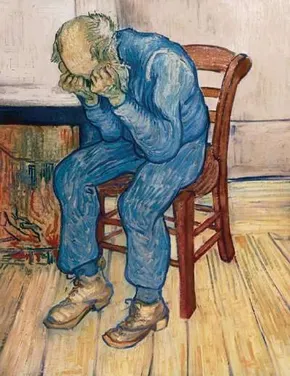
Monday’s can be difficult.
You wake up, it’s the start of a new week and you might be feeling a bit anxious.
Your mind is racing ahead to all the things you need to do and all the challenges you need to overcome.
It can be a bit daunting.
So here’s a mood booster for you.
A reason why you don’t need to feel so bad, why you should be grateful for your life and why today is a great day to be you.
In the difficult realm of human experience, suffering is the dark thread that, when weaved through the tapestry of our lives, adds depth to all experiences.
In other, less metaphorical terms, you can’t have up’s without having some down’s.
Therefore, and as perplexing as it sounds, the embrace of pain, rather than its avoidance, gives your life meaning and fulfilment.
I’m not saying anything new here, by the way.
It’s been said countless times before by fitness bro’s on TikTok and by ancient philosophers. I guess, I’m just only realising how true it is.
People talking about it theoretically isn’t much use.
Only when you experience suffering and difficulty (and the consequent fulfilment/happiness out the other side) does this message become real.
So, admittedly, this is more theory (I can’t force you to experience suffering by reading a blog post).
But I want to give a whistle stop tour of the most compelling arguments for why suffering and hardship are necessary parts of life’s journey to fulfilment.
And also to remind you that you must go out and experience this in order to learn it.
Nietzsche, in his work “Human, All Too Human,” argues that suffering isn’t just a byproduct of existence but a necessity for personal growth.
Imagine a potter working with clay, sculpting, moulding, and more often than not, reshaping the clay into the desired figure.
Nietzsche suggests our souls are like that lump of clay, and suffering is the potter’s hand, moulding us, making us more profound, more empathetic, and more connected.
While joy is the gentle caress of the potter, the harsher, more forceful nudges — those come from suffering.
And both are necessary to build a beautiful piece of work.
To Nietzsche, then, those who have not suffered have not fully lived.
Ryan Holiday, in “The Obstacle is the Way,” brings forth a Stoic approach.
As you can tell, I’m a big fan of the Stoics.
Ryan suggests that barriers aren’t impediments but rather signposts pointing us toward personal growth.
Life, in the Stoics view, is akin to a river where obstacles — rocks, rapids, and waterfalls — shape its course.
Just as water doesn’t bemoan the rock but finds its way around, over, or under it, we too can find purpose and meaning in our challenges.
It’s not about avoiding the obstacle but about navigating it, learning from it, and letting it propel us to uncharted territories.
Paul Bloom, a prominent psychologist, reinforces this from the cognitive perspective.
In his discourse, he often alludes to the importance of suffering in deriving profound meaning from life.
Consider the beauty of a sunset after a stormy day or the taste of food after hours of hunger.
Bloom hints that our psychological framework is such that the highs feel higher after the lows.
The peaks of joy, thus, are accentuated by the troughs of pain.
No matter where you look; suffering is an inescapable part of the human narrative.
But it isn’t a merciless antagonist; rather, it’s a complex character that, if engaged with courage and understanding, can pave the way to profound fulfilment.
I want to make it clear that I’m not encouraging or glamourising poverty here.
As you’ll see from my work on personal finance, being comfortable and confident when it comes to money is paramount to a fulfilling life.
This is more about recognising that day-to-day difficult things (like tough conversations with loved ones about something that upset you, sacrificing short-term pleasures to invest the money for future, or working out to keep yourself healthy) are necessary for a happy life and should not be avoided.
In the modern age, where the emphasis often rests on the pursuit of relentless positivity and the avoidance of pain, these insights serve as a refreshing, albeit challenging, perspective.
It is a call to lean into suffering, to understand it, to embrace it, and most importantly, to let it shape, mould, and refine us.
It reminds us that while suffering is uncomfortable, it’s also the crucible within which the most resilient and empathetic among us are forged.
So the next time the dark clouds of anguish gather overhead, remember: the rainbow that follows is worth the rain (for The UK Office Fans among you; do you know which ‘philosopher’ said that?)
Take it easy,
Max
Leave a Reply