
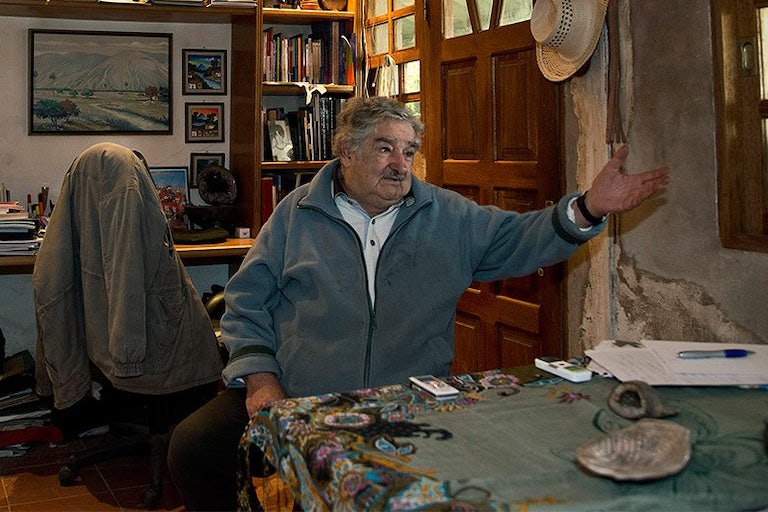
In the southern hemisphere, nestled between its more renowned neighbours, lies the small nation of Uruguay.
While it might be dwarfed in size and recognition, it deserves headlines far more than Bolsinaro’s Brazil, thanks to an unconventional leader: José Mujica.
For those unacquainted with this unique figure, Mujica served as the 40th President of Uruguay from 2010 to 2015.
But to define him by his political position would be a disservice to the man who once was a guerrilla fighter, who spent over a decade in prison (much of it in solitary confinement), and who, despite ascending to the pinnacle of power, chose to live in a humble farmhouse rather than a presidential palace and to donate 90% of his salary to charity whilst in leadership.
Why should we learn about José Mujica?
Because, in a world filled with selfish and ill-equipped politicians, he stands out as a testament to integrity, humility, and unwavering commitment to one’s principles.
Something which, regardless of political alignment, one can standby and respect.
In my eyes, he is as close to a modern day Marcus Aurelius as we’ll ever have.
Now, let’s dive deeper into the essence of this modern-day hero. With a quick outline of his life and history, before unpacking it with 5 philosophical lessons we can learn from him.
Mujica’s Story
José Mujica, born in 1935, began his political journey as a member of the Tupamaros, a left-wing urban guerrilla group in Uruguay during the 1960s and early 1970s.
The group focused on social justice issues and opposed the government’s authoritarianism.
In 1972, he was captured by the authorities and spent over a decade in prison, much of it in solitary confinement.
During his imprisonment, he studied extensively, delving into philosophy and political literature.
This period marked a transformation in Mujica’s ideology from armed resistance to a more pacifist and inclusive approach.
After the military dictatorship ended in Uruguay, Mujica was released from prison in 1985.
Over the following years, he actively participated in the country’s re-democratization process and joined the political arena.
In 2009, José Mujica became the presidential candidate for the left-wing Broad Front coalition.Despite his unconventional background, he won the presidential election and took office in 2010.
He chose to live in a farmhouse instead of the presidential palace, donated 90% of his salary to charity, and focused on social justice, environmental sustainability, and dialogue.
I urge you to google photos of him on his tractor, and meeting Obama. They’re brilliant.
1. The Power of Reading: From Guerrilla Fighter to a Beacon of Hope
Mujica’s early years as a Tupamaro guerrilla fighter paint a picture of a man unafraid to stand up for his beliefs.
And he was certainly that; but I don’t want to glorify guerilla fighting here.
It’s the evolution from a fighter to a pacifist statesman that is interesting about Mujica.
In interviews now, he openly speaks about the foolishness of his youth in the guerilla fighting troop.
He doesn’t apologise for what he believed in, but rather, realised conflict wasn’t the way to achieve his goals.
Like the Stoics of ancient Rome, Mujica understood that the real battle wasn’t against externalities but against his own vices and prejudices.
And so after his guerilla days he reformed his own character and cultivated virtue within himself.
This became his main aim in life; to be kind to others and to always act virtuously.
And how did he undergo that transformation? Through books and education.
Check out the Fill the Gap resources page for the stuff Mujica would’ve loved to have read.
2. Freedom in Frugality: The World’s ‘Poorest’ President
Earning this title not as a slight but as a badge of honor, Mujica donated 90% of his salary to charity as President.
Living a life of profound simplicity, he showcased that leadership isn’t about personal enrichment but about serving one’s people and setting an example.
Watch the interview he does with the BBC. They go and visit his humble farmhouse from where he carries out his duties as President.
It’s truly remarkable.
He embodies much of the financial advice we advocate for at FTG: don’t spend on frivolous unnecessary items. They won’t make you any happier.
This donation of his salary wasn’t merely a gesture; it was a statement.
Like Seneca’s teachings on wealth and contentment, Mujica demonstrated that true riches don’t lie in material acquisitions but in the wealth of one’s heart.
3. Living at one with Nature: Championing the Environment
Recognizing the existential threat of climate change, Mujica emphasized sustainable living.
His policies and his personal choices reflected a deep respect for nature and an understanding of humanity’s responsibility towards it.
Which ties really nicely into frugality and investing too.
The things you truly want in life cannot be bought (respect, admiration, friends).
And so you don’t need to spend loads on flights, cars, fancy foods etc. You can live frugally, be happier, spend less + help the environment.
4. Living for Others: A Stalwart of Social Justice
Mujica’s tenure was characterized by progressive policies, from supporting LGBTQ+ rights to championing sustainable agriculture.
He envisioned a society where justice wasn’t an abstract ideal but a tangible reality for all.
Which is huge in stoicism and a lot of ethics I admire and teach at FTG.
One must live for something bigger than oneself to achieve meaning.
And this can just be small things like being generous to others, or understanding or engaging in active listening when you’re talking to someone.
Either way, living for yourself is a quick way to unhappiness.
So live for others.
5. The Art of Communication: Embracing Dialogue and Peace
Having borne the brunt of violence in his youth, Mujica consistently advocated for peace and dialogue.
His leadership approach underlined the idea that true progress is achieved when we talk to each other, not past each other.
6. The Wisdom in Conscious Consumption
Beyond just financial frugality, Mujica’s life symbolized a deeper philosophy: that of valuing the intangible riches of life – love, nature, and time – over material wealth.
As we often talk about here, money can never and will never buy the things that make life worth living.
Yes, of course, we all need to be financially comfortable and confident. No one is advocating for anything else.
But what is so special about Mujica is that he assessed what he needed.
Realised it wasn’t very much.
And hence didn’t let money, and the hedonic adaptation that comes with consuming more and more, take over his life.
He was comfortable and confident with money, despite not having loads of it.
His version of this was living on a farm and giving 90% of his money to charity.
For you, being comfortable and confident with money might look like investing each month to save for a house deposit in 8 years.
It’s about recognising and knowing yourself.
7. Impact on Others: The Legacy of a Humble Hero
Mujica’s legacy is a testament to the power of authenticity, conviction, and humility in leadership.
In an era where politics often seems detached from the common man, he stood as a beacon of hope and a model of servant leadership.
I truly believe he deserves more recognition, for his character and unique leadership.
He deserves respect.
Power can corrupt. Most of the time it does.
But Mujica proved there is a potential for using power to inspire and make the world a better place.
Conclusion
In a global tapestry of (often corrupt or irresponsible) leaders, José Mujica shines not because of the opulence or grandeur typically associated with power, but because of his simplicity, authenticity, and a profound sense of duty.
Mujica’s life is reminiscent of a line from a poem or a passage from a philosopher’s diary, emphasising the profound impact of humility, dedication, and love.
His life is a lesson that true leadership is less about wielding power and more about empowering those you serve.
Try and be more Mujica today, if you can.
Love, as always,
Max
Leave a Reply